
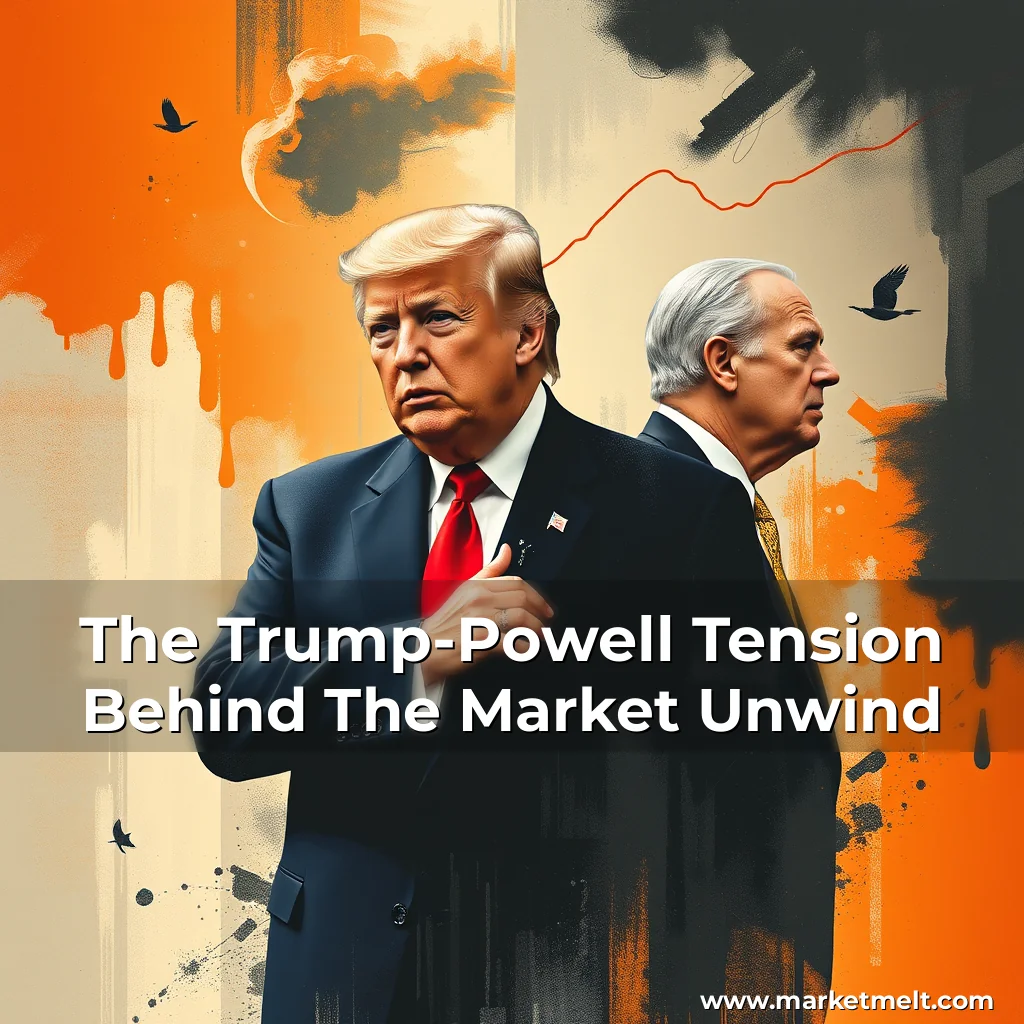
Market volatility has surged to unprecedented levels in recent weeks, prompting fears of the end of U.S. exceptionalism trade. As President Donald Trump’s attacks on the Federal Reserve under Chair Jerome Powell escalate, the market has reacted with a rare triple selloff across stocks, Treasuries, and the dollar.
Trump’s Open Attacks on Powell
Trump’s criticism of Powell has been swift and public, with the president labeling him a “major loser” on multiple occasions. He has also accused Powell of being too late and wrong, and even threatened to remove him from office before his term ends in 2026. These comments have sparked concern among investors, who view Powell’s independence as a cornerstone of stability.
Confirmation of Powell’s Possible Removal
National Economic Council Director Kevin Hassett has confirmed that the administration is considering removing Powell before his term ends. This confirmation has fueled the market’s concerns about the impact of a potential change in leadership on the Fed’s monetary policy.
Market Reaction
The market has reacted decisively to Trump’s attacks on Powell. Since April 2, 2025, the following assets have experienced significant declines:
* The iShares 20+ Year Treasury Bond ETF (TLT) has dropped more than 6%
* The Invesco DB USD Index Bullish Fund ETF (UUP) has fallen 5.8%
* The SPDR S&P 500 ETF Trust (SPY) has tumbled over 8%
These declines challenge the traditional assumption that Treasuries typically gain when risk assets fall. The breakdown of this historical inverse correlation has led many to wonder if investors are abandoning Treasuries.
What the Official Data Shows
The latest U.S. Treasury International Capital (TIC) data, covering February, does not show large-scale foreign divestment. In fact, foreign investors have net purchased long-term U.S. securities, including Treasuries, equities, and corporate bonds.
Agency Securities and ETF Flows
However, February is now outdated. The latest exchange-traded fund (ETF) flows data through April 18 reveal no evidence of broad-based exodus from Treasury ETFs. Despite some rotation out of long-duration ETFs, short- and mid-duration Treasury ETFs have attracted strong inflows during the month.
Speculation about China
There is speculation that major foreign holders, especially China, could be reducing exposure to U.S. government debt in retaliation for tariffs. However, Goldman Sachs analysts argue that the recent dislocations are more likely related to position unwinds by levered investors than significant real money selling.
ETF Flows and the Dollar/Yuan Exchange Rate
The ETF flows data also suggest that investors are seeking to hedge against rate volatility and political uncertainty. The dollar/yuan exchange rate behavior does not support the idea of major Chinese repatriation, and the opposite has happened.
No Sign of a Treasury Crisis
The bottom line is that while some repositioning out of longer-dated Treasuries has been observed, ETF flows suggest no broad investor flight from the Treasury market. If anything, there is a tilt toward shorter maturities, reflecting a desire to hedge against both rate volatility and political uncertainty. Until more recent TIC data is available in June, ETF flows remain the best window into investor sentiment, and so far, they suggest the panic narrative may be premature.
Conclusion
The market unwind continues to unfold, with investors seeking to hedge against rate volatility and political uncertainty. While the Trump-Powell tension has sparked concerns about the impact of a potential change in leadership on the Fed’s monetary policy, the data suggests that the panic narrative may be premature. As the situation continues to unfold, investors will need to remain vigilant and adapt to changing market conditions.