
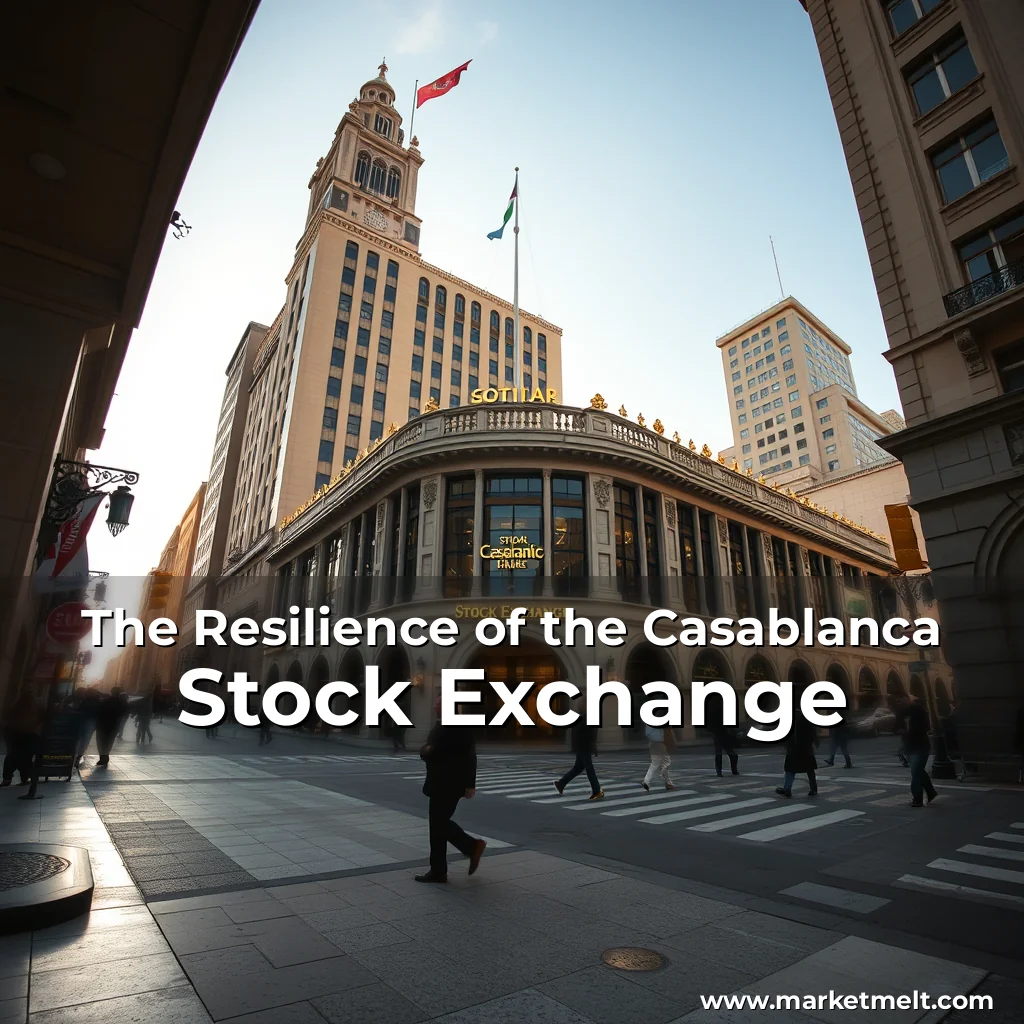
The MASI index bounced back from a sharp decline on April 7, closing up 1.35% at 16,479 points, following the shock of the previous day’s announcement. The market’s resilience can be attributed to institutional investors’ arbitrage behavior and market psychology, as well as the globalization of information and the algorithmic sensitivity of trading platforms.
- Arbitrage behavior: Institutional investors often use arbitrage strategies to profit from price discrepancies between markets. In the case of the Casablanca Stock Exchange, this behavior can lead to rapid price adjustments and reduced volatility.
- Market psychology: The fear and uncertainty caused by the announcement can lead to market volatility, but also creates opportunities for investors to take advantage of the situation.
- Globalization of information: The widespread availability of information on the internet and social media can spread fear and uncertainty rapidly, but also enables investors to make informed decisions and react quickly.
The MASI’s exposure to the global market is not as direct as one might think. While the Casablanca market is only modestly exposed to the United States in direct trade terms, it is indirectly affected by international capital flows and the overall risk-averse climate.
| Factors affecting the MASI’s exposure to global markets | ||
| • Direct trade exposure | • International capital flows | • Overall risk-averse climate |
| • Market fundamentals | • Global economic trends | • Institutional investor behavior |
The fundamentals of listed companies remain strong, according to some experts. However, the recent decline may be a “technical adjustment” rather than a worrying structural signal.
” investors should not panic, but rather focus on the underlying fundamentals of listed companies. The fundamentals of listed companies remain strong, and we’re even seeing some resilience in defensive sectors like retail and telecoms. Panic is not warranted, but it’s also not a good idea to stay in cash forever.”
The future remains uncertain, and the MASI could experience further short-term shocks if global volatility continues. However, if tensions between Washington and the rest of the world ease, the market could rebound quickly.
- Rebound potential: If tensions between Washington and the rest of the world ease, the MASI could rebound quickly.
- Volatility remains: If trade tensions persist, volatility will likely remain elevated.
- Investor advice: Investors should stay selective and focus on companies with solid balance sheets, low debt, and strong, recurring cash flow generation.
The message from investors is clear: in an interconnected world, no financial market is truly immune. The question now is whether this setback was merely a temporary scare-or the opening act of a longer correction cycle.
The behavior of institutional investors who use arbitrage strategies to profit from price discrepancies between markets. In the case of the Casablanca Stock Exchange, this behavior can lead to rapid price adjustments and reduced volatility.
The study of how investors perceive and respond to market information. In the case of the Casablanca Stock Exchange, market psychology can lead to market volatility, but also creates opportunities for investors to take advantage of the situation.
The widespread availability of information on the internet and social media can spread fear and uncertainty rapidly, but also enables investors to make informed decisions and react quickly.
The phenomenon where market shocks in one market can lead to market shocks in other markets, often due to the globalization of information and the algorithmic sensitivity of trading platforms.
The risk that the economy will enter a period of economic decline, often characterized by reduced economic activity, increased unemployment, and decreased economic output.
Sectors that are less affected by economic downturns, such as retail and telecoms. These sectors often provide a stable source of revenue and income during periods of economic uncertainty.
The sensitivity of trading platforms to algorithmic changes, which can lead to rapid price adjustments and increased market volatility.
The Importance of Investor Selectivity
Investors should stay selective and focus on companies with solid balance sheets, low debt, and strong, recurring cash flow generation. This is sound advice not only for the Casablanca Stock Exchange but for all markets going through turbulent times.
- Focus on fundamentals
- Choose companies with strong balance sheets
- Invest in companies with low debt
- Invest in companies with strong, recurring cash flow generation
The message from investors is clear: in an interconnected world, no financial market is truly immune. Investor awareness
Investors should be aware of the current market conditions and stay informed about the latest developments. This will help investors make informed decisions and react quickly to changes in the market. Uncertainty is a natural part of the investment process
Investing always involves some level of uncertainty, but being aware of the current market conditions and staying informed can help investors navigate through turbulent times.
The Role of Institutional Investors
Institutional investors play a crucial role in shaping the market’s behavior and responding to market shocks. Their arbitrage behavior, market psychology, and globalization of information can all impact the MASI’s exposure to global markets.
- Arbitrage behavior
- Market psychology
- Globalization of information
The MASI’s resilience can be attributed to institutional investors’ arbitrage behavior and market psychology, as well as the globalization of information and the algorithmic sensitivity of trading platforms. The fundamentals of listed companies remain strong, according to some experts.
The Future of the Casablanca Stock Exchange
The future remains uncertain, and the MASI could experience further short-term shocks if global volatility continues. The MASI could rebound quickly if tensions between Washington and the rest of the world ease, especially as negotiations are reportedly underway, notably with the European Union. However, if trade tensions persist, volatility will likely remain elevated. Investors should stay selective and focus on companies with solid balance sheets, low debt, and strong, recurring cash flow generation. The question now is whether this setback was merely a temporary scare-or the opening act of a longer correction cycle.
The Resilience of the Casablanca Stock Exchange
The MASI index bounced back from a sharp decline on April 7, closing up 1.35% at 16,479 points, following the shock of the previous day’s announcement. The MASI’s exposure to the global market is not as direct as one might think. The future remains uncertain, and the MASI could experience further short-term shocks if global volatility continues. In conclusion, the Casablanca Stock Exchange has proven itself to be resilient in the face of turbulent times. While the recent decline was a shock to the system, the fundamentals of listed companies remain strong, and the market is likely to recover in the long run. Investors should stay informed and be prepared for any eventuality, but they should also be cautious not to make hasty decisions based on short-term market fluctuations.