The Cheese Cost Ledger
Price your home-made cheese by the weight you actually eat, compare it with the cheese you would otherwise buy, and see how many batches a press or a cave takes to pay for itself
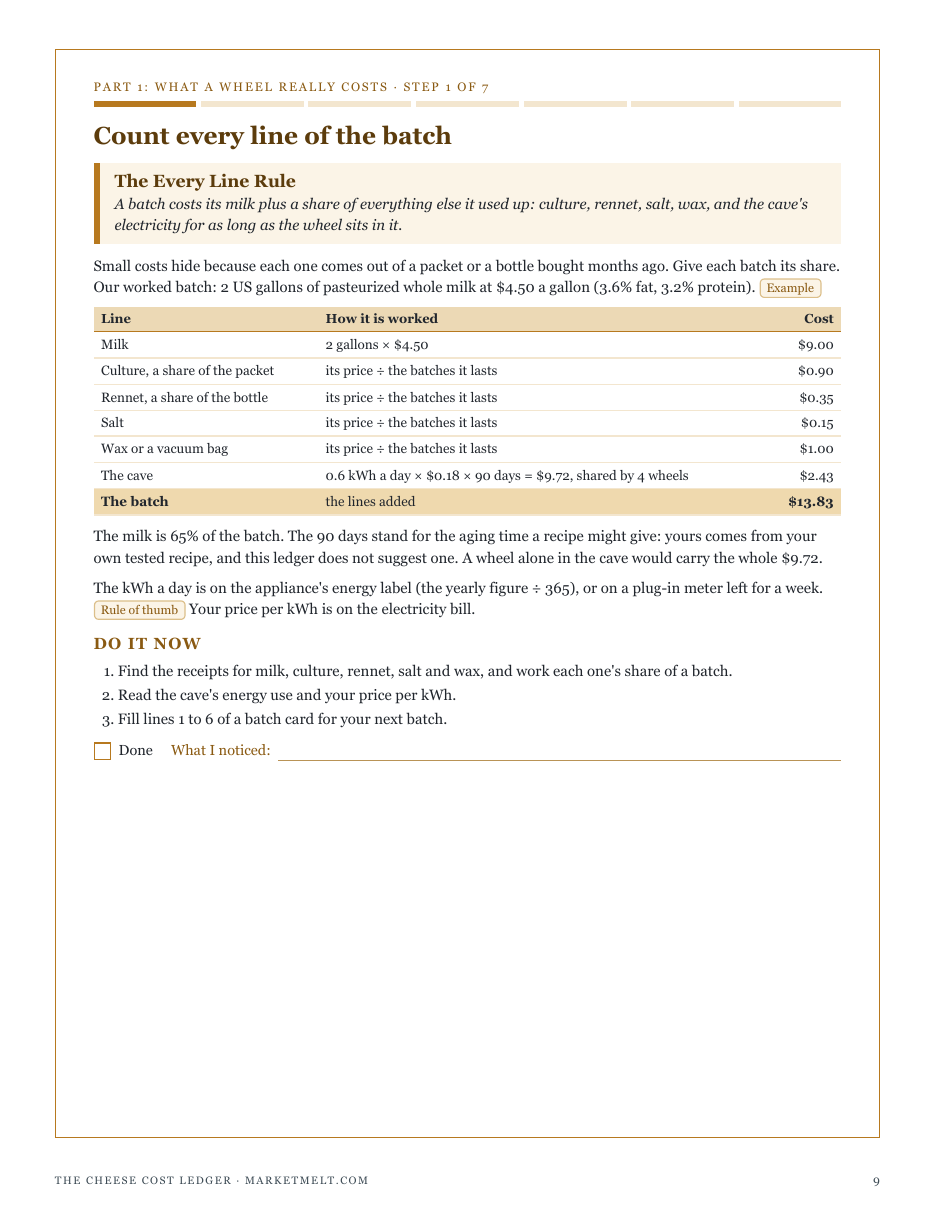
Our Milk-to-Cheese Yield Calculator estimates how much cheese a batch of milk makes and says real yields run under it; our aging guide shows a wheel losing weight in the cave. None of our tools puts a price on the cheese you finally cut and eat, and a price per kilogram is only as honest as the kilogram behind it. The Cheese Cost Ledger counts every line of the batch (milk, culture, rennet, salt, wax and the cave's electricity), then divides by the weight you eat: after your own measured recovery and the rind you trim. In the worked example, two gallons of whole milk make 788 g of cheese on paper and 681 g on the plate, so a $13.83 batch costs $20.31 a kilogram, not the $15.58 it looks like at the press. It then compares that price with the cheese you would really buy, draws the payback line for a $400 press and cave (61 batches in the example against farmstead cheese, never against everyday cheese), and compares styles by the milk cost per kilogram of solids. Every figure is computed from our own calculators, and every example is labelled as one. It is cost arithmetic only: not a recipe, and it sets no pH, salt, humidity or aging target; a cost or yield figure does not make a home-made cheese safe. Included: 24 printable pages with seven steps, a batch cost card, a recovery log, a comparison and payback sheet, a wheel ledger, reference tables and a quickstart, plus a personalised sheet worked from the numbers you enter in the Milk-to-Cheese Yield Calculator.
Look inside
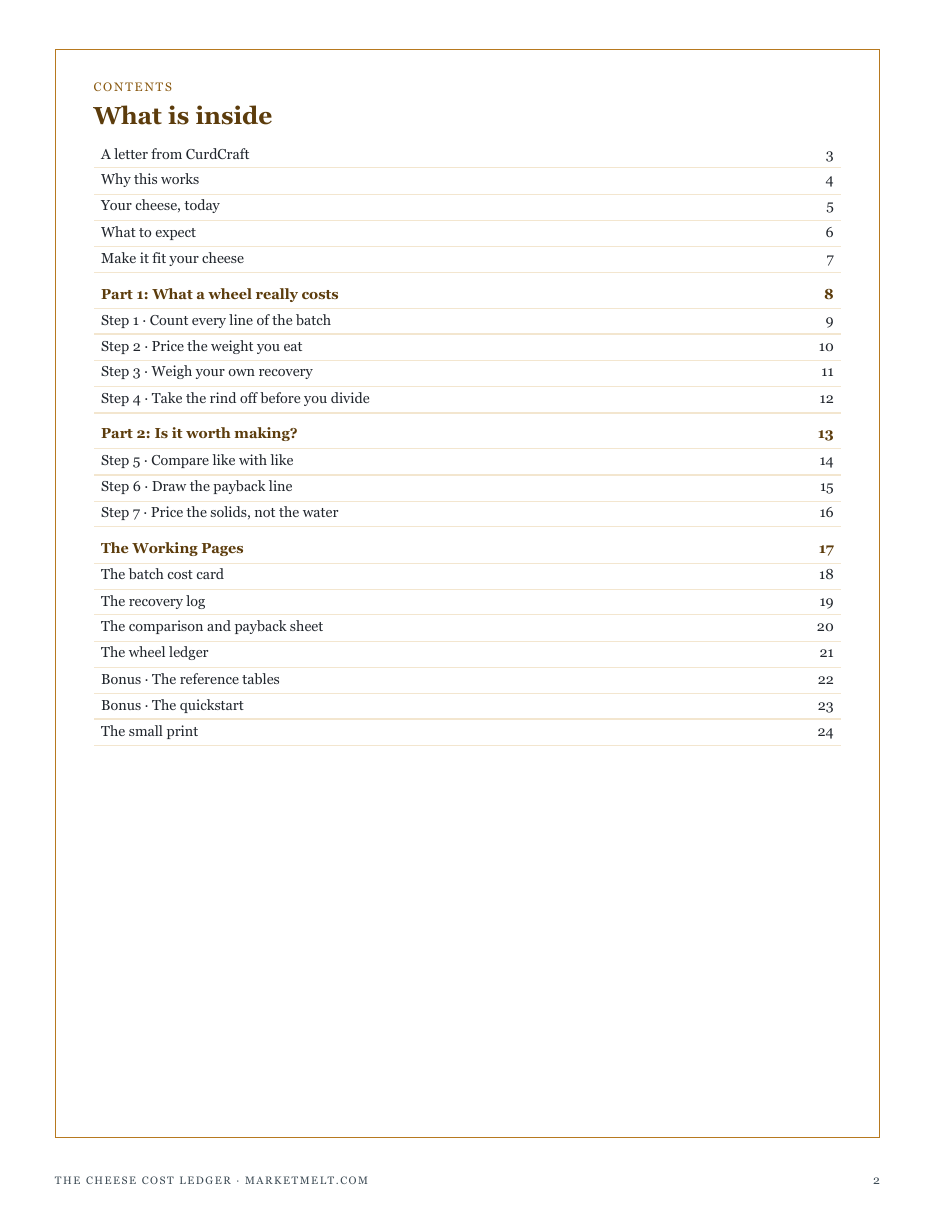
Two full pages from the ledger, exactly as printed. Click either to read it at full size before you decide.
What is in it
- The Every Line Rule: the whole batch, itemised: milk, culture, rennet, salt, wax and the cave's electricity shared across the wheels in it
- The Eaten Weight Rule: price the cheese at the weight you eat, not the weight off the press, with the milk counted in kilograms
- The Own Scale Rule: measure your real recovery against the yield formula over five batches
- The Rind Rule: take the trimmed rind and wax off before you divide, for a price per kg, per lb and per 30 g serving
- The Like-for-Like Rule: your cost per kg against the cheese you would really buy, and the store price at which making it breaks even
- The Payback Line: how many batches and years your equipment takes to pay back, what moves the line, and what a batch earns per hour
- The Water Rule: compare styles by the milk cost per kilogram of solids, not per kilogram of cheese
- Four working pages: a batch cost card, a recovery log, a comparison and payback sheet, and a wheel ledger
- Reference tables of milk cost per kg by moisture and milk price and the break-even store price by recovery and trim, and a quickstart
- A personalised sheet worked from the figures you enter in the Milk-to-Cheese Yield Calculator
- ✓ 24 printable pages
- ✓ 10 sections, worksheets and templates
- ✓ A second PDF worked out from the numbers you enter
- ✓ No account needed, just an email address
- ✓ Instant download; link valid 7 days
Price includes any taxes. Sold by GrabURL, who handle checkout and support. The charge appears on your statement as GrabURL.
The ledger picks up where the free Milk-to-Cheese Yield Calculator leaves off. The calculator estimates how much cheese a batch of milk makes; the ledger prices that cheese by the weight you actually eat, after your measured recovery and the rind you trim, sets it against the cheese you would otherwise buy, and draws the payback line for a press or a cave, using the same arithmetic as our Cheese Moisture Reference. It is cost arithmetic only: it is not a recipe, sets no pH, salt, humidity or aging target, and a cost or yield figure does not make a home-made cheese safe. Follow a tested recipe, and see our food safety guide.